Dipped Canvas for Conveyor Belts: Adhesion, Flex Fatigue, and Belt Service Life
Authored by: Heavy Industrial Textile Engineering Team, Weixinfabric
Technical Focus: Conveyor Belt Carcass Design, Interfacial Bond Dynamics, Dynamic Flex Endurance, and Service Life Extension
1. The Strategic Role of Dipped Canvas in Heavy-Duty Conveyor Belting
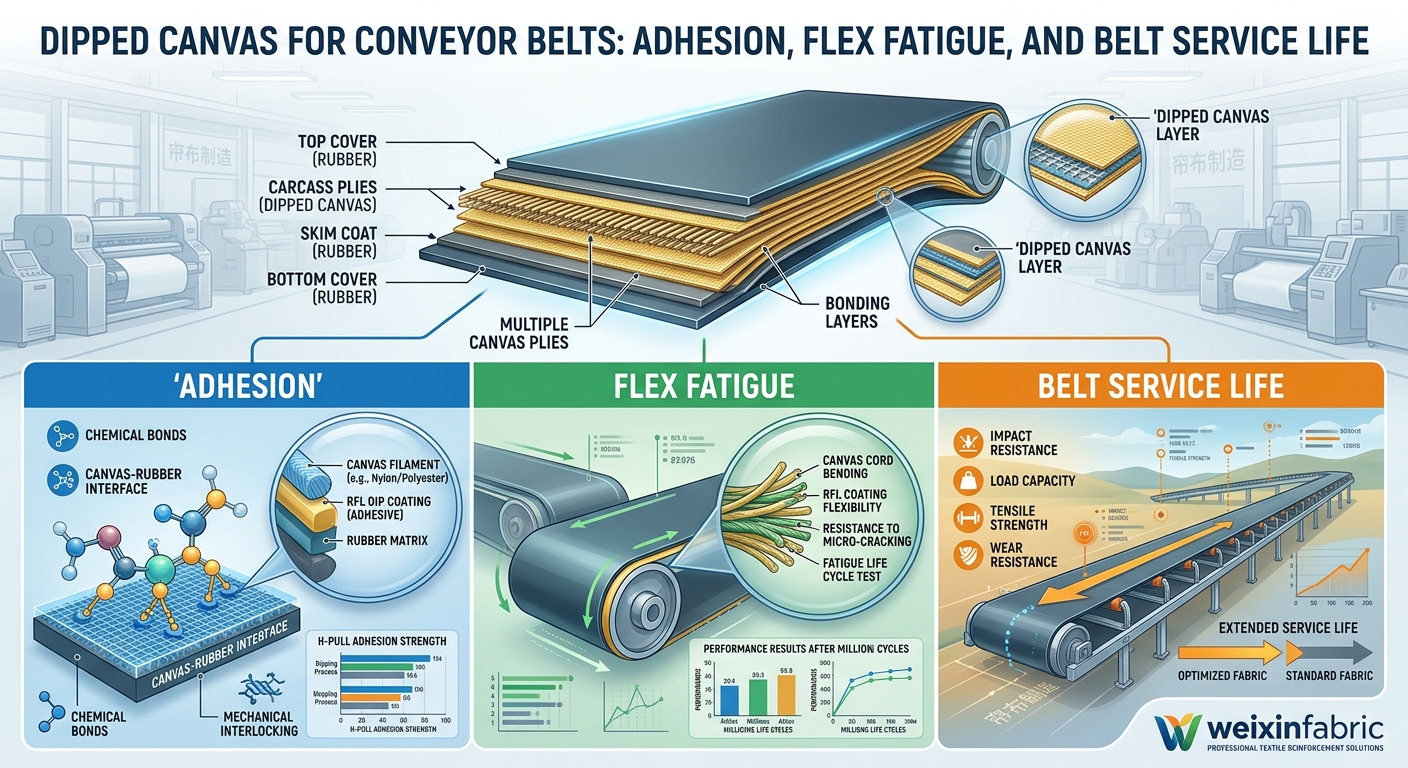
Industrial conveyor belting systems operating in mining, aggregate handling, port terminals, and heavy manufacturing rely on multi-ply synthetic carcass fabrics to sustain extreme tensile loads, heavy material impacts, and continuous drive-pulley flexure. The interior skeletal reinforcement—commonly referred to as dipped canvas or carcass fabric—determines the operational limit and overall service life of the belt.
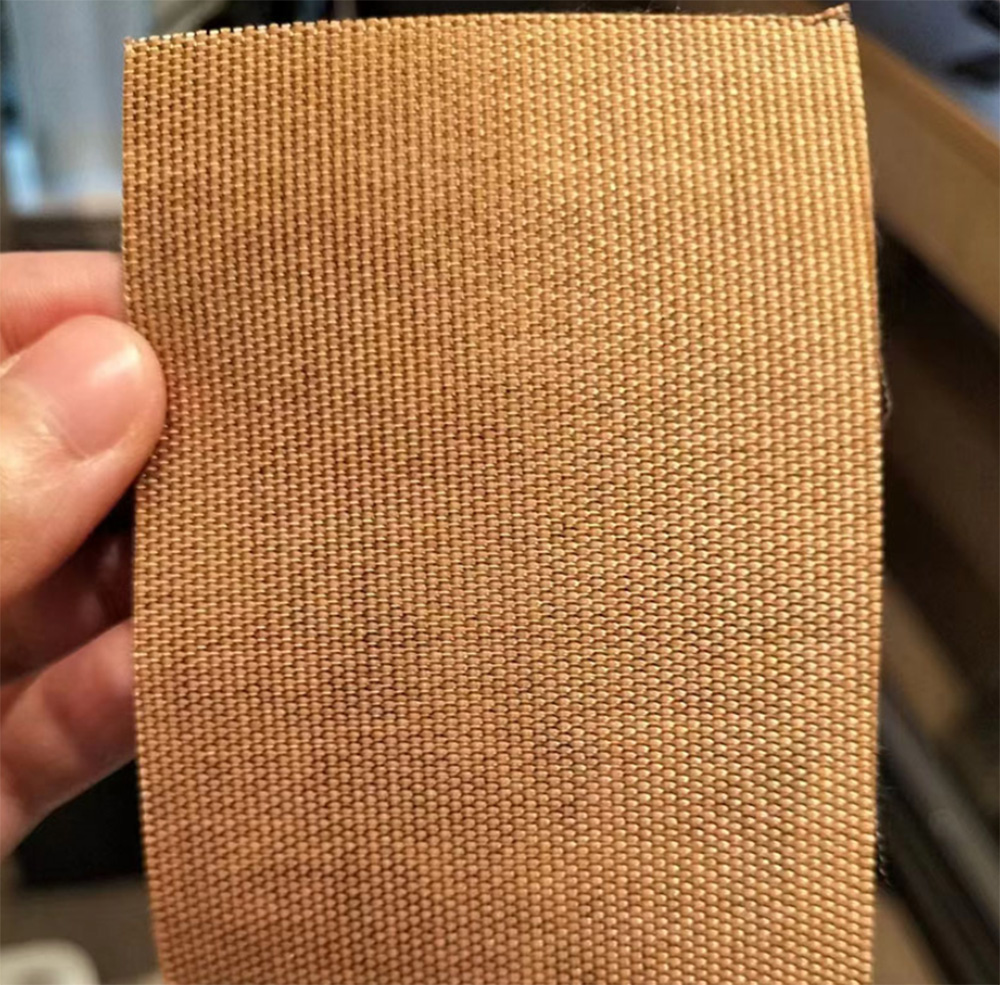
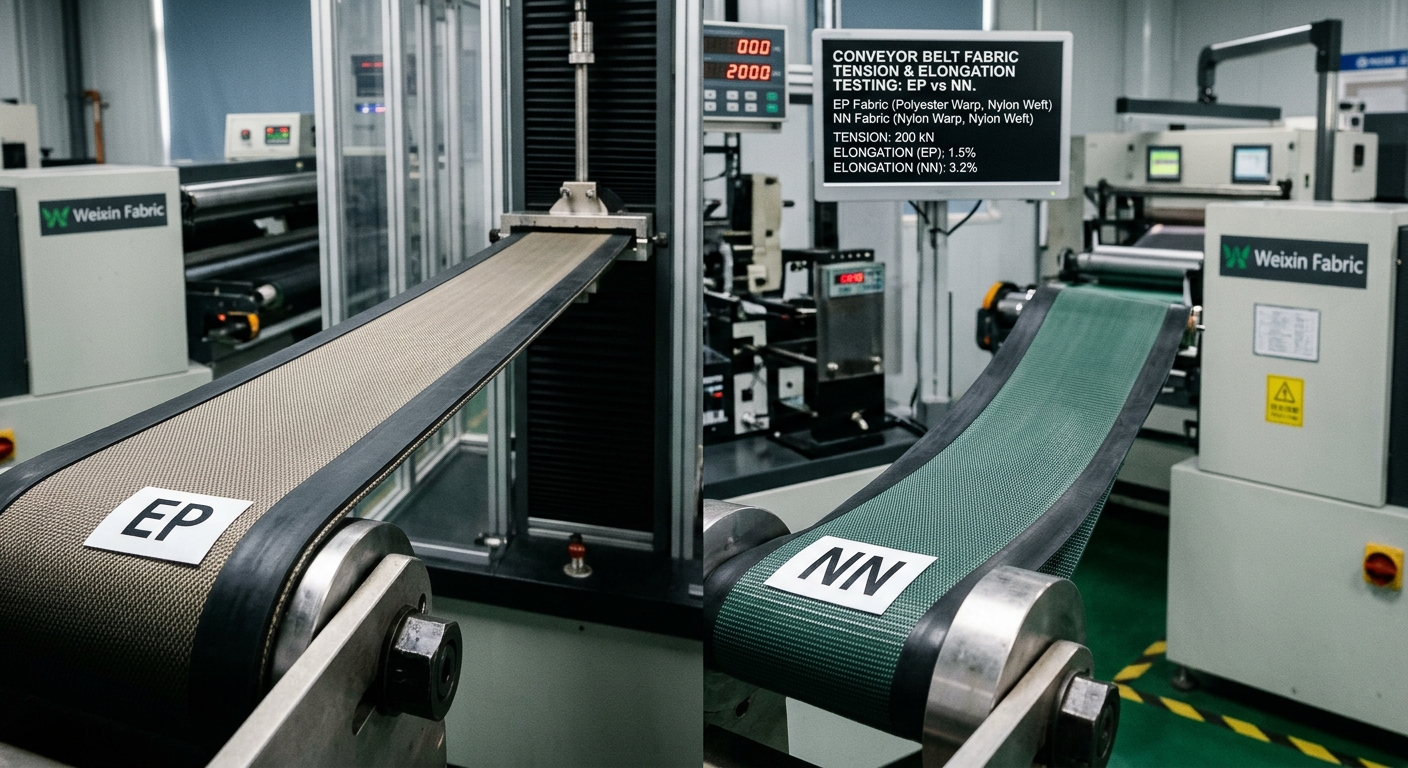
As a leading Chinese specialized cord and carcass fabric solution provider, Weixinfabric engineers high-tenacity Polyester/Nylon (EP) and Nylon/Nylon (NN) dipped canvases. By optimizing yarn twisting, weave construction, and Resorcinol-Formaldehyde-Latex (RFL) chemical dipping technology, we provide global belting manufacturers with carcass solutions designed for maximum rubber adhesion, high flex fatigue endurance, and extended operational lifespan.
2. Interfacial Adhesion: The Chemical and Mechanical Foundation
Conveyor belt failure frequently occurs at the interface between the synthetic fabric canvas and the rubber skim coat. Untreated synthetic yarns (PET and Nylon) lack reactive functional groups to bond with vulcanized rubber. Chemical surface activation via RFL dipping is necessary to establish an enduring interfacial bond.
Key Factors Driving High Peel and H-Pull Adhesion:
- Chemical Interlocking: Hydroxyl (-OH) groups in the resorcinol-formaldehyde resin form strong hydrogen bonds with polyamide/polyester polymer chains, while active vinyl pyridine latex co-vulcanizes with rubber sulfur compounds.
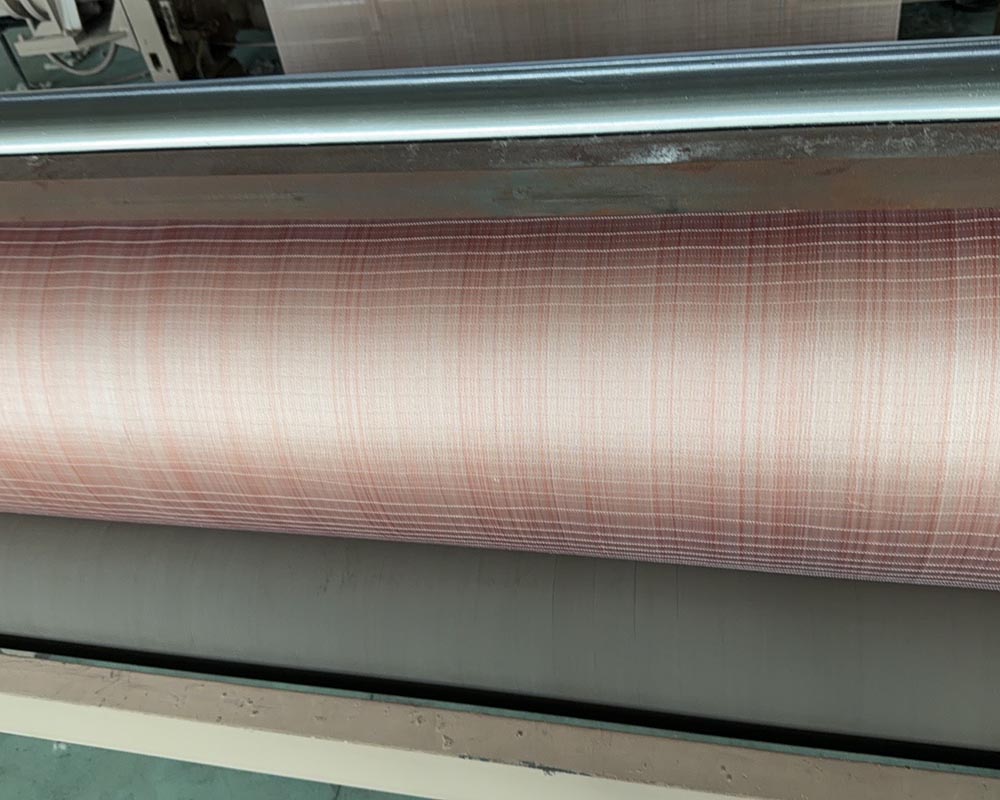
- Optimized Dip Pick-Up (DPU): Precise control of chemical pick-up ensures full filament encapsulation without forming a brittle outer shell, yielding consistent H-pull adhesion values exceeding 180 N/cm.
- Deep Yarn Penetration: Controlled squeeze-roll hydraulic pressure drives the RFL dip into the core of twisted warp and weft bundles, preventing interior fiber friction during dynamic flexing.
3. Flex Fatigue Resistance: Overcoming Continuous Dynamic Bending
As a conveyor belt travels around drive, tail, and take-up pulleys millions of times during its operational lifecycle, the internal dipped canvas undergoes continuous cyclical tension and compression. Inferior fabrics suffer from micro-cracking within the RFL coating, leading to ply separation, cord degradation, and sudden belt snap.
Comparative Canvas Material Mechanics
| Canvas Type | Warp / Weft Chemistry | Flex Fatigue Resistance | Impact & Troughability Performance | Primary Conveyor Application |
|---|---|---|---|---|
| EP Dipped Canvas | High-Tenacity PET / Nylon 6 or 66 | Excellent long-term dimensional stability; low stretch under dynamic tension. | High modulus, superior troughing capability, minimal impact elongation. | Long-distance, high-speed, heavy-haul overland conveyors. |
| NN Dipped Canvas | Nylon 6 or 66 / Nylon 6 or 66 | Outstanding energy absorption; high resilience under repeated shock loads. | High elasticity, excellent fatigue life across small pulley diameters. | Quarrying, scrap yards, primary crushers, short-center loaders. |
| Straight-Warp Canvas | High-Denier PET / Aramid / Nylon | Maximum load bearing with zero crimp degradation under peak bending. | Ultra-high impact puncture resistance, thin multi-ply profile. | Underground coal mining, port loading terminals, high-impact rock drop zones. |
4. Engineering Strategies for Maximizing Belt Service Life
At Weixinfabric, our technical team implements strict engineering controls throughout the textile manufacturing process to eliminate premature conveyor belting degradation:
- Multi-Zone Thermal Fixing: Passing dipped canvas through multi-stage drying and heat-setting ovens locks in target High-Modulus Low-Shrinkage (HMLS) characteristics, keeping field thermal shrinkage below 1.0%.
- Uniform Crimp Balance: Precision tensioning on air-jet and rapier looms balances warp and weft tension, ensuring equal load distribution across all carcass plies.
- Abrasion-Resistant Edge Finish: Sealed fabric selvages prevent humidity penetration and chemical degradation along the belt edges during wet or corrosive mining operations.
5. Why Weixinfabric is Your Premier Dipped Canvas Solution Partner
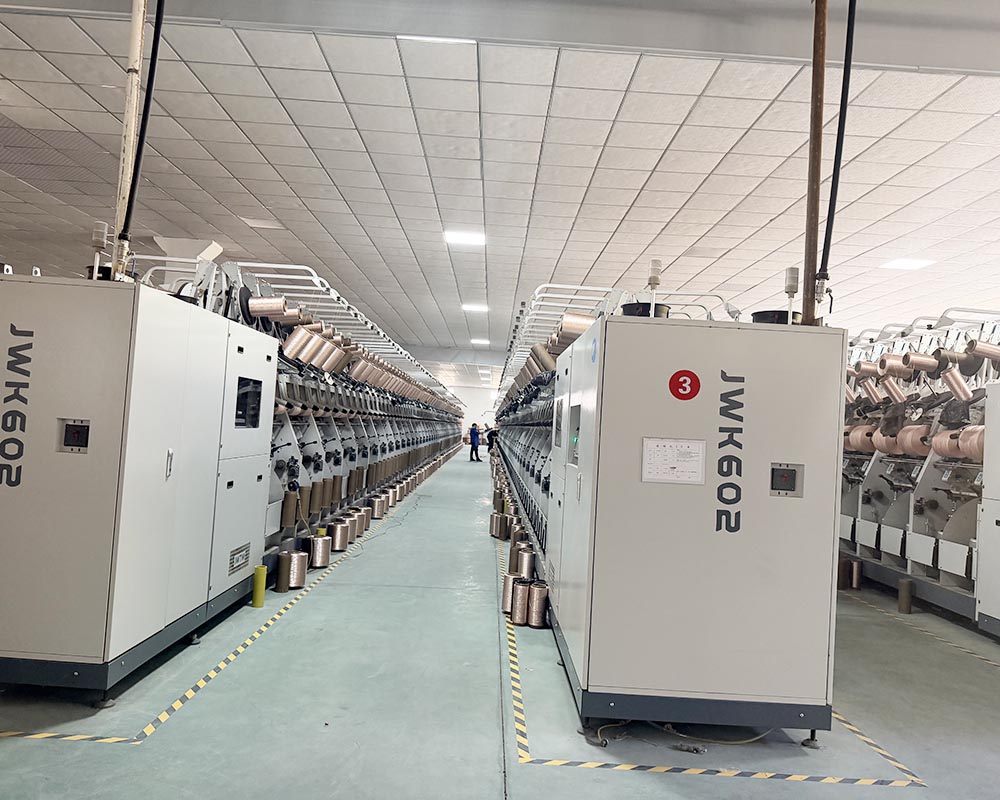
As a specialized Chinese producer of industrial reinforcement textiles, Weixinfabric integrates raw filament selection, high-speed cabling, custom canvas weaving, and advanced RFL dip coating under a ISO 9001 and IATF 16949 certified quality management system.
We work collaboratively with global conveyor belt manufacturers to customize canvas width, weight (EP100 to EP600 grade plies), twist levels, and RFL dip formulations to meet demanding operational specifications.
6. Technical Collaboration & Inquiries
Maximizing conveyor belt service life requires aligning carcass canvas selection with dynamic operational stress. By specifying Weixinfabric’s high-adhesion, fatigue-resistant dipped canvases, manufacturers can reduce field belt failures and lower total cost of ownership for end-users.
Contact Weixinfabric today to consult with our industrial textile engineers, review technical datasheets, or request custom-dipped canvas samples.